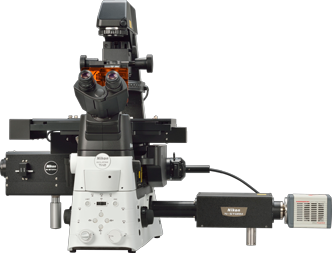

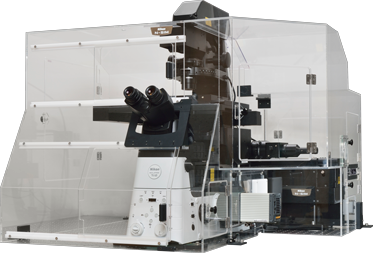
提供常规光学显微镜的两倍分辨率
使用基于UCSF授权的结构化照明显微镜技术的创新方法,N-SIM可以产生常规光学显微镜的两倍分辨率和0.6秒/帧的时间分辨率,从而实现微细胞内结构及其功能的详细可视化。结合N-SIM和共聚焦显微镜,您可以灵活地选择共焦图像中的位置,并可轻松切换到超分辨率查看,从而获得更多细节。
Description

活细胞成像是传统光学显微镜分辨率的两倍
N-SIM使用尼康创新的“结构化照明显微镜”技术。通过与尼康著名的CFI Apochromat TIRF 100XC Oil物镜(NA 1.49)配对,这种强大的技术与N-SIM几乎相当于传统光学显微镜的空间分辨率的两倍(约115nm *),并能够细化细胞内结构和互动功能。
*该值是测量在3D-SIM模式下用488nm激光激发的100nm珠的FWHM。 在TIRF-SIM模式下,使用用488nm激光激发的40nm珠粒可实现86nm。

Macrophages (J774 cells expressing mVenus-SNAP23) phagocytosing opsonized beads that were incubated with Alexa555 labeled secondary antibodies after fixation.
The beads without red signals are in phagosomes containing mVenus-SNAP23.
Photographed with the cooperation of: Drs. Chie Sakurai, Kiyotaka Hatsuzawa and Ikuo Wada, Fukushima Medical University School of Medicine.

N-SIM image (3D-SIM)

Conventional widefield image
Microtubules in B16 melanoma cell labeled with YFP
Objective: CFI Apochromat TIRF 100XC Oil (NA 1.49)
Image capturing speed: approximately 1.8 sec/frame (movie)
Reconstruction method: Slice
Photographed with the cooperation of: Dr. Yasushi Okada, Laboratory for Cell Polarity Regulation, Quantitative Biology Center, RIKEN

N-SIM image (3D-SIM)

Conventional widefield image
Endoplasmic reticulum (ER) in living HeLa cell labeled with GFP
Objective: CFI Apochromat TIRF 100XC Oil (NA 1.49)
Image capturing speed: approximately 1.5 sec/frame (movie)
Reconstruction method: Slice
Photographed with the cooperation of: Dr. Ikuo Wada, Institute of Biomedical Sciences, Fukushima Medical University School of Medicine
时间分辨率为0.6秒/帧惊人的超分辨率显微镜
N-SIM为结构化照明技术提供超快速成像功能,时间分辨率高达0.6秒/帧,对于活细胞成像(使用TIRF-SIM / 2D-SIM模式;3D-SIM成像高达约1 秒/帧(切片重建))。

Dynamics of mitochondria stained with Mito-Tracker red
Cristae in mitochondria are visualized and the dynamics of mitochondria can be observed.
Mode: 3D-SIM (slice reconstruction)
Objective: CFI Apochromat TIRF 100XC Oil (NA 1.49)
Image capturing interval: approximately 1 sec. (movie)
获取更大的视野
可以获得具有66μm正方形的视野的超分辨率图像,比常规成像区域大四倍。 扩大的成像区域大大提高了从更大视野受益的应用/样本的吞吐量,例如神经元,减少获得必要数据所需的时间和精力。

Reconstructed image size: 1024 x 1024 pixels (33 μm x 33 μm with a 100X objective)

Reconstructed image size: 2048 x 2048 pixels (66 μm x 66 μm with a 100X objective)
Growth cone of NG108 cell labelled with TRITC-phalloidin (F-actin, orange) and Alexa Fluor® 488 (microtubules, green)
Sample courtesy of: Dr. Shizuha Ishiyama and Dr. Kaoru Katoh, The National Institute of Advanced Industrial Science and Technology (AIST)
多种观察模式
TIRF-SIM / 2D-SIM模式
该模式以惊人的对比度高速捕获超分辨率2D图像。与常规TIRF显微镜相比,TIRF-SIM模式利用全内反射荧光观察的两倍分辨率,有助于更好地了解细胞表面上的分子相互作用。

TIRF-SIM image

Conventional TIRF image
Plasma membrane of B16 melanoma cell labeled with YFP
Objective: CFI Apochromat TIRF 100XC Oil (NA 1.49)
Photographed with the cooperation of: Dr. Yasushi Okada, Laboratory for Cell Polarity Regulation, Quantitative Biology Center, RIKEN
3D-SIM模式
3D-SIM照明技术将轴向分辨率提高到269 nm,具有样品光学切片的能力,能够在更高的空间分辨率下可视化更细致的单元格结构。

Luminal surface of the organ of Corti at postnatal day 1. (Mouse)
Green: F-actin, red: acetylated-tubulin
Photographed with the cooperation of: Drs. Kanoko Kominami, Hideru Togashi, and Yoshimi Takai, Division of Molecular and Cellular Biology, Kobe University Graduate School of Medicine/Faculty of Medicine

N-SIM image (3D-SIM)

Conventional widefield image
Bacillus subtilis bacterium stained with membrane dye Nile Red (red), and expressing the cell division protein DivIVA fused to GFP (green).
The superior resolution of N-SIM system allows for accurate localization of the protein during division.
Reconstruction method: Slice
Photos courtesy of: Drs. Henrik Strahl and Leendert Hamoen, Centre for Bacterial Cell Biology, Newcastle University

3D-SIM (Volume view)

3D-SIM (Maximum projection)
Mouse keratinocyte labeled with an antibody against keratin intermediate filaments and stained with an Alexa Fluor® 488 conjugated second antibody.
Reconstruction method: Stack
Photos courtesy of: Dr. Reinhard Windoffer, RWTH Aachen University
简易的成像方法切换
可以使用共焦显微镜系统(如A1 +)同时配置N-SIM,并且可以在超分辨率成像和共聚焦成像之间轻松切换成像方法。
可以在共焦图像中指定SIM图像的期望位置并以超分辨率获取。

5激光多色超分辨成像
尼康N-SIM系统允许多达5激光器的多通道成像,使研究分子水平上感兴趣的多个蛋白质的动态相互作用。

Human U2OS cell during mitosis metaphase
The cell is labeled green (kinetochore protein CENP-B), red (alpha-tubulin) and blue (DNA).
Photo courtesy of: Dr. Alexey Khodjakov, Wadsworth Center, Albany NY
双波长同步超分辨率成像
通过使用可选的双摄像头成像适配器*将两个EMCCD/sCMOS相机连接到显微镜,可以同时进行488 nm和561 nm激发的双波长超分辨率成像。
*安道尔科技有限公司产品

两台相机成像适配器(适用于N-SIM)
*实际产品的设计可能略有不同。
Growth cone of NG108 cell expressing GFP-LifeAct (F-actin, green) and mCherry-tubulin (microtubules, red)
Photos courtesy of: Dr. Kaoru Katoh, The National Institute of Advanced Industrial Science and Technology (AIST)
超分辨率显微镜的物镜
硅胶浸渍物镜
硅胶浸渍物镜采用高粘度硅油浸渍液体,其折射率与活细胞的折射率密切相关。 它允许在长期,延时成像期间捕获高分辨率,多色3D图像直到细胞的顶端。 通过宽波长范围确保卓越的色差校正和高透射率。

CFI SR HP Plan Apochromat Lambda S 100XC Sil
浸渍物镜
使用波前像差测量的镜头矫正和探测为超分辨率显微镜提供了超级光学性能的SR镜头,将不对称像差的出现降至最低水平。
SR HP物镜提供高耐用性,可实现高功率激光激发和最小轴向色差,并且在超分辨率成像中表现出优异的性能,无需在N-SIM和N-STORM系统之间切换物镜。


Left:CFI SR HP Apochromat TIRF 100XC Oil; Right:CFI SR Plan Apochromat IR 60XC WI
干镜头
干镜头现在与N-SIM以及共焦显微镜兼容,因此无需切换镜头就可以使用共聚焦成像和超分辨率成像。 低倍率和宽视场干透镜可以在样品组织的周围进行高分辨率观察。
*干目标支持2D-SIM和3D-SIM(切片重建)


Left:CFI Plan Apochromat Lambda 60XC; Right:CFI Plan Apochromat Lambda 40XC